Long Waves of Innovation:
Please describe connection between Schumpeter and Kondratieff
The connection between Joseph Schumpeter and Nikolai Kondratieff lies in their shared effort to explain how economic development unfolds in long-term cycles driven by innovation — what are now often called the “long waves” or “Kondratieff waves” of innovation.
Here’s a clear overview of how their ideas connect:
🧩 1. Kondratieff: The Long Waves of Economic Growth
- Nikolai Kondratieff (1892–1938), a Russian economist, discovered that capitalist economies move in long cyclesof roughly 40–60 years.
- These waves consist of alternating periods of rapid growth (“upswings”) and slower or declining periods (“downswings”).
- Kondratieff found empirical evidence for these waves in prices, wages, and production data from the late 18th century onward.
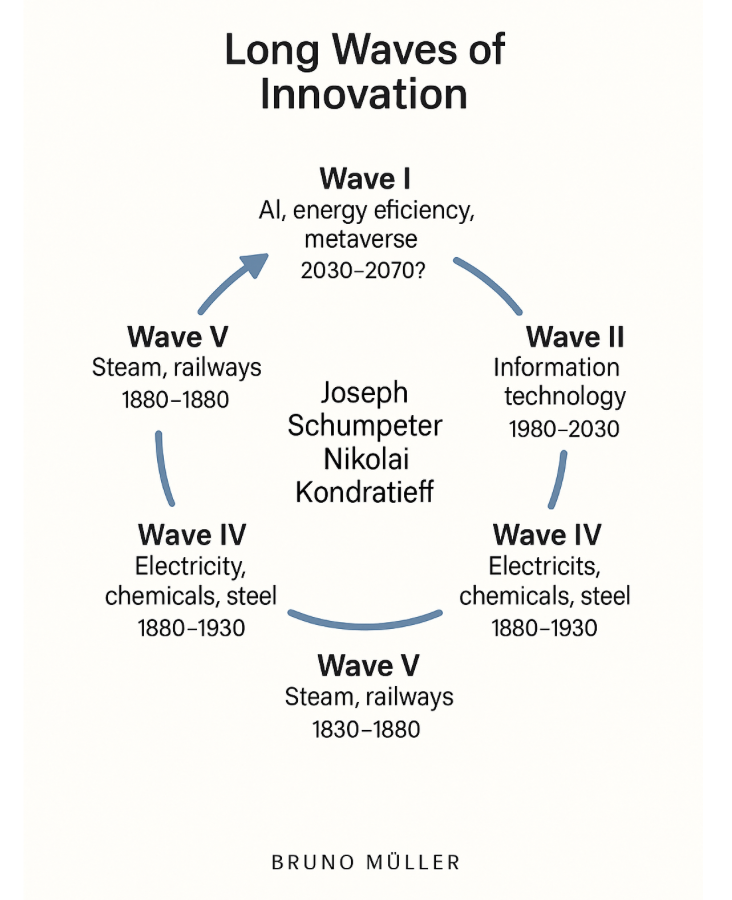
- He identified successive waves, each driven by major technological revolutions:
- Industrial Revolution (late 18th century)
- Steam and Railways (mid-19th century)
- Electricity, Chemicals, Steel (late 19th century)
- Automobiles and Oil (20th century)
- Information Technology (late 20th century onward)
💡 2. Schumpeter: Innovation as the Engine of the Cycle
- Joseph A. Schumpeter (1883–1950), an Austrian economist, provided the theoretical foundation for these waves.
- He argued that innovation and entrepreneurship are the drivers of economic evolution, not equilibrium-seeking forces.
- Schumpeter described a process of “creative destruction” — where new technologies, business models, and industries replace old ones.
- He linked Kondratieff’s long waves to clusters of radical innovations that cause structural transformations in the economy.
🔗 3. The Connection
- Schumpeter adopted Kondratieff’s empirical findings and gave them a dynamic innovation-based explanation.
- He proposed that each Kondratieff wave corresponds to a cluster of major innovations, such as the steam engine, electricity, or digitalization, that reshape industries and societies.
- In his view:
- Entrepreneurs introduce these innovations.
- Investment booms follow.
- As innovations mature, growth slows — leading to recession or restructuring.
- New innovation clusters eventually trigger the next wave.
- 🧭 In Essence
- Kondratieff measured the rhythm of long economic waves.
Schumpeter explained the mechanism — innovation and entrepreneurship — that creates them.