
What Decades of International Business Experience Have Taught Me About the „Intelligent Age“
Artificial intelligence is transforming businesses at a pace that is extraordinary even for experienced managers. Yet, the more powerful the technology becomes, the more important I believe one distinctly human capability will be – one that cannot simply be automated:
Asking the right questions
After decades of international business experience, working with global corporations, start-ups, universities and entrepreneurs, I no longer see my role as that of a traditional consultant.
Today I see myself co-creating as
„Strategic AI Sparring Partner“
Not as someone who sells ready-made answers, but as someone who combines experience, critical thinking and modern AI to enable better decisions.
Experience Takes on New Meaning in the AI Age
My professional career has taken me through very different worlds: international corporations (Fortune 100), Siemens, Infineon Technologies and Deutsche Telekom, global business development, technology and semiconductor markets, start-ups and investments, and later working with young entrepreneurs at universities.
Along the way, I have learnt:
„Technologies change“
The fundamental questions behind successful business development change surprisingly little.
- What problem are we really solving?
- Why should a customer pay for it?
- Where can we create a sustainable competitive advantage?
- Which assumptions underlying our business model might be wrong?
- What changes are we currently overlooking?
- And when is it wiser to change a strategy rather than defend it with ever-increasing effort?
This is precisely where AI becomes particularly interesting to me.
AI Is Not an Oracle – It Is a „Thinking Amplifier“
- I do not see artificial intelligence primarily as a machine that takes thinking away from us.
- Quite the opposite.
„Used intelligently, AI can expand, accelerate and challenge our thinking“
- It can analyse business models from different perspectives, develop scenarios, compare competitors, monitor technological developments, challenge hypotheses and make emerging risks more visible.
- Today, questions that once required days or even weeks of research can be explored within minutes.
- But speed alone does not create good strategy.
AI understands data and patterns. What it does not possess is decades of personal experience with customers, organisations, negotiations, corporate cultures, power structures, poor decisions or crises.
For me, therefore, the real value lies in the combination of:
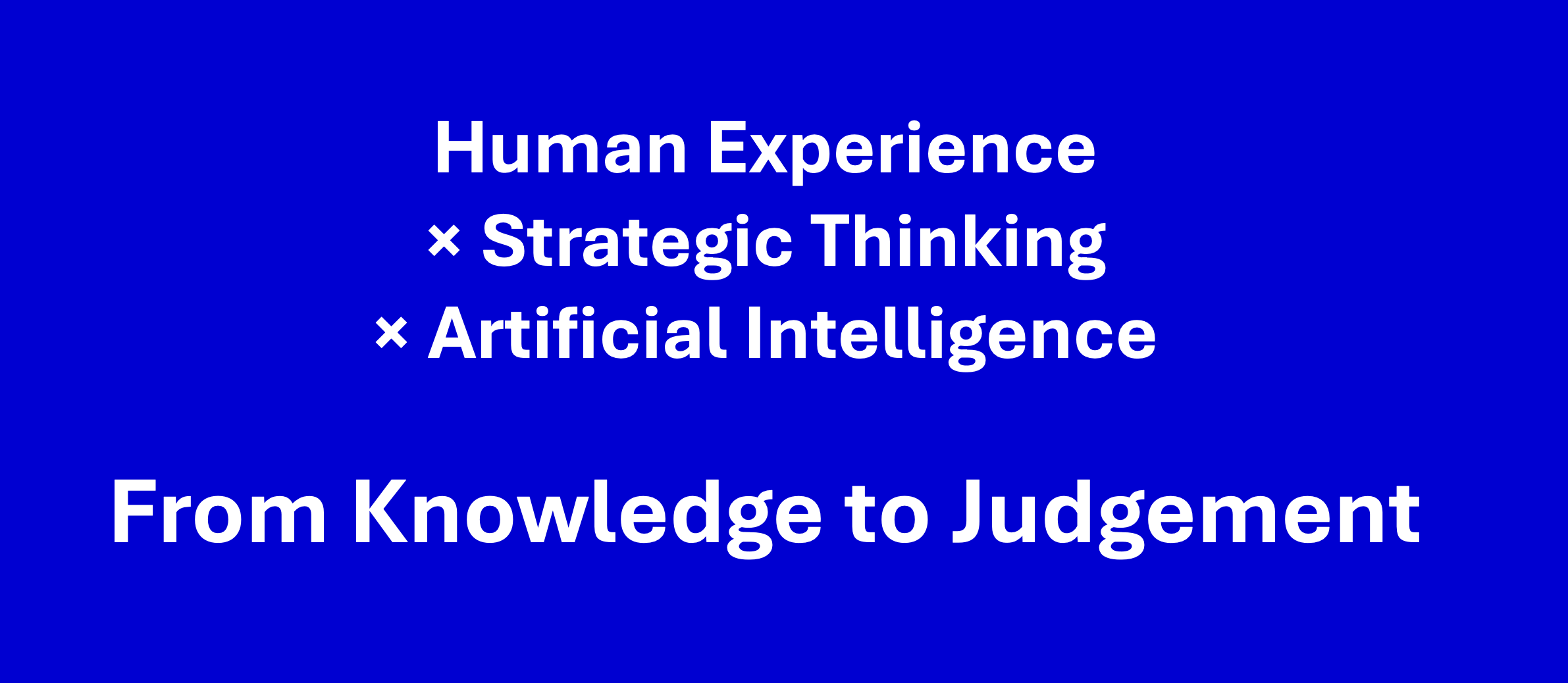
In the Industrial Age, knowledge was a decisive competitive advantage.
In the Intelligent Age, knowledge is becoming increasingly accessible.
- AI systems can access vast bodies of knowledge within seconds, structure information and use it to develop possible courses of action.
- The bottleneck is therefore shifting.
In future, access to information will not be the decisive factor. What will matter is our ability to put information into context, challenge it critically and translate it into responsible decisions.
-
I call this strategic judgement.
And this is precisely where experience becomes valuable again.
Not as a rear-view mirror based on the principle of “We have always done it this way”, but as a frame of reference that helps us assess new possibilities more effectively.
First Principles Instead of Management Autopilot
One of the most important lessons I have learnt from many years in business is this:
- Organisations often invest enormous amounts of time and energy in solutions before they have truly understood the underlying problem.
That is why „First Principle Thinking“ plays a central role in my approach today:
- I begin by breaking a strategic question down into its fundamental components:
- What do we actually know?
- What are we merely assuming?
- Which conditions have changed?
- What would we do differently today if we were starting from scratch?
Combined with AI, this approach becomes particularly powerful. AI can systematically challenge assumptions, develop counterarguments and simulate alternative scenarios.
In this way, AI does not become an automated decision-maker, but a sophisticated sparring partner for our thinking.

Five Perspectives on Strategic Business Development
My experience has led me to an approach centred around
Five Interconnected Perspectives:
- Business Model Discovery
Challenging existing business models and identifying new opportunities at an early stage. - First Principle Thinking
Rethinking problems from their foundations rather than merely optimising existing structures. - Early Crisis Detection
Identifying technological, economic and organisational changes before they develop into existential problems. - Reality Check
Consistently testing strategies, projects and investments for feasibility, commercial viability and sustainable customer value. - AI strengthens all four perspectives
Provided that humans retain responsibility for judgement and decision-making.
Why Sparring Is Becoming More Important
- The more complex markets become, the more difficult it is for decision-makers to challenge their own assumptions.
- That is simply human nature.
- Anyone who spends a long time working on a strategy, product or business will inevitably develop convictions. Yet those very convictions can eventually become blind spots.
A good sparring partner therefore does not need to agree all the time.They should ask questions, change perspectives, expose contradictions and sometimes simply ask:
Is this really a viable business model – or merely a fascinating idea?
- AI significantly expands the possibilities of this kind of sparring. Hypotheses can suddenly be tested more quickly, opposing arguments developed and alternative scenarios compared.
- I see my role as bringing these possibilities together with entrepreneurial experience and critical distance.
My Role in the Intelligent Age
Today, I do not want to be the person who tells entrepreneurs what their future will look like.
Our world is changing far too quickly for that.
I see my role differently today:
Developing better questions together, identify opportunities earlier, make risks visible and critically examine strategic decisions.
- In doing so, I combine decades of international corporate and start-up experience with strategic analysis and the capabilities of modern artificial intelligence.
- Not technology for technology’s sake.
- Not AI simply because everyone is talking about AI.
- But AI where it can create tangible value for people, businesses and customers.
Where „Experience Meets Curiosity“
Perhaps this is my most important personal insight from the transition from manager to AI sparring partner:
Experience is valuable in the Intelligent Age only when it remains connected to curiosity.
- Those who rely solely on their past risk judging the future by yesterday’s standards.
- Those who simply follow the latest technology, on the other hand, risk overlooking fundamental commercial and human realities.
- The most interesting position lies somewhere in between.
- Experience provides orientation.
„Curiosity opens up new perspectives“
First Principle Thinking challenges established assumptions.
- Artificial intelligence expands the space of possible answers.
That is exactly where I see my role.
I am not here to be loud, I am here to bring clarity.
About Bruno Müller
Bruno Müller combines decades of international corporate and start-up experience with strategic analysis and modern artificial intelligence. His work focuses on Business Model Discovery, First Principle Thinking, Early Crisis Detection and Reality Checks.
As a Strategic AI Sparring Partner, he supports entrepreneurs, start-ups and decision-makers in critically challenging business models, identifying new opportunities at an early stage and making emerging risks visible – before assumptions turn into costly decisions.